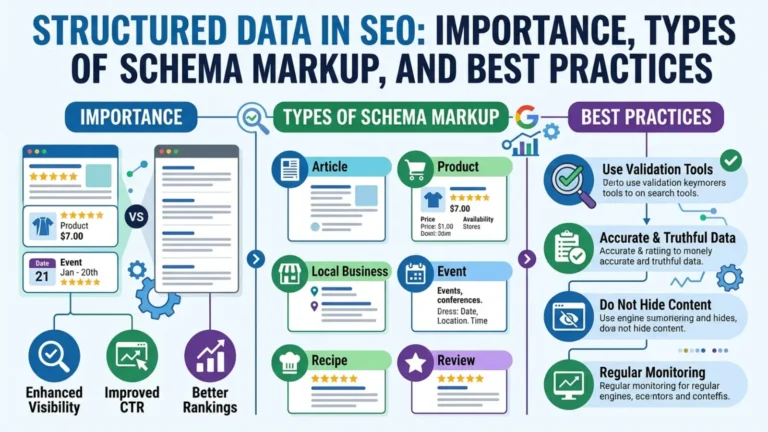
structured data in SEO
Search engine optimization (SEO) involves more than optimizing keywords, creating quality content, and building backlinks. Search engines also need to understand what a webpage is about and how its information is connected. This is where structured data and schema markup play an important role in modern SEO.
Structured data helps search engines interpret website content by providing information in a standardized, machine-readable format. When implemented correctly, it can make eligible pages qualify for enhanced search appearances, such as product details, review information, and breadcrumb displays.
Whether you operate an e-commerce store, a local business, a corporate website, or a content-driven platform, understanding schema markup can help you build a stronger technical SEO foundation.
In this guide, we explore what structured data is, why it matters, the different types of schema markup, and how to implement it effectively.
What Is Structured Data in SEO?
Structured data is organized information added to a webpage’s code to help search engines understand its content more precisely.
For example, a webpage may contain a business name, address, phone number, opening hours, and services. Although visitors can read this information, structured data explicitly identifies what each detail represents.
Schema markup is a standardized vocabulary commonly used to describe these details. It is maintained by Schema.org, an initiative supported by major search platforms.
For example, schema markup can help identify whether a webpage contains:
- An article or blog post
- A product available for purchase
- A local business and its contact information
- A frequently asked questions section
- A breadcrumb navigation trail
- An event with a specific date and location
Google can use supported structured data to understand page content and determine whether a page is eligible for certain enhanced search appearances. However, adding schema markup does not guarantee higher rankings or rich results. Source: Google Search Central
Why Is Structured Data Important for SEO?
Structured data supports SEO by making important information easier for search engines to interpret. Its benefits extend beyond simply adding code to a website.
1. Helps Search Engines Understand Website Content
Search engines use multiple signals to interpret webpages. Structured data provides explicit context about entities, attributes, and relationships.
For example, a product page can identify a product’s name, brand, price, availability, and review information where applicable. This helps clarify the purpose and meaning of the information presented on the page.
2. Creates Opportunities for Rich Results
Some types of structured data can make pages eligible for enhanced search results.
Depending on the schema type, content, and Google’s eligibility requirements, search listings may display additional information, such as product prices, availability, review ratings, or breadcrumb navigation.
These enhanced appearances can make a result more informative and potentially encourage users to visit the website. However, Google decides whether eligible markup is displayed.
3. Supports a Better Search Experience
Structured data can help search engines present relevant information in a more useful format. For example, product details may help shoppers compare options, while breadcrumb information can communicate where a page sits within a website’s hierarchy.
A clearer search presentation can help users decide which result best matches their needs.
4. Strengthens Local SEO Signals
Businesses with physical locations can use LocalBusiness structured data to identify details such as their business name, address, telephone number, opening hours, and other relevant attributes.
This can help search engines understand a business and its location. However, structured data alone does not guarantee better local rankings or a knowledge panel.
5. Improves Content Classification
Article, BlogPosting, and other relevant schema types help describe the nature of a webpage.
For content publishers, this can clarify the relationship between an article, its headline, author, publisher, publication date, and featured image.
6. Supports a More Consistent Technical SEO Strategy
Structured data encourages website owners to organize information consistently across relevant pages. When combined with descriptive URLs, internal linking, useful content, and sound technical SEO, it contributes to a well-structured website.
The key is to use schema markup to accurately describe the content that already exists—not to replace quality content or other SEO fundamentals.
What Are the Main Types of Schema Markup?
Schema.org provides a broad vocabulary for describing businesses, products, content, places, events, and many other entities. The right schema type depends on the purpose and content of each webpage.
Here are some of the most useful schema types for SEO.
1. Organization Schema
Organization schema describes a company, institution, or other organization.
It can include information such as the organization’s name, website, logo, contact details, and official profiles.
Best for: Corporate websites, company websites, and business organizations.
SEO value: Helps search engines identify the organization associated with a website.
2. LocalBusiness Schema
LocalBusiness schema describes a business or a specific physical business location.
Relevant properties may include the business name, address, telephone number, opening hours, and geographic details.
Best for: Restaurants, retail stores, clinics, offices, and service providers with physical locations.
SEO value: Helps search engines understand business location and operating information.
3. Article Schema
Article schema describes editorial content, including news articles and informational articles.
Common properties include the headline, author, publication date, modification date, publisher, and image.
Best for: News websites, editorial publishers, and informational blogs.
SEO value: Helps search engines interpret article information and can support eligibility for relevant search features.
4. BlogPosting Schema
BlogPosting is a more specific type of Article schema designed for blog posts.
It can identify the headline, author, publisher, featured image, and publication details.
Best for: Company blogs, educational content, industry insights, and thought leadership articles.
SEO value: Provides structured context about blog content and its authorship.
5. Product Schema
Product schema describes a product and its relevant attributes. Depending on the page and implementation, it can be used with offer information, availability, pricing, and review details.
Best for: E-commerce stores, product manufacturers, and product detail pages.
SEO value: Eligible product pages may qualify for enhanced product search appearances.
6. BreadcrumbList Schema
BreadcrumbList schema identifies a webpage’s position within a website hierarchy.
For example:
Home → Services → SEO Services → Technical SEO
This structure helps communicate the relationship between a page and its parent sections.
Best for: Websites with multiple categories, service sections, product categories, and large content libraries.
SEO value: Can support breadcrumb displays in eligible Google search results.
7. Service Schema
Service schema describes a service offered by an organization or business.
Relevant information may include the service name, description, provider, and service area where applicable.
Best for: Digital marketing agencies, consulting firms, logistics companies, storage providers, and other service-based businesses.
SEO value: Helps describe the services featured on a webpage. Service markup itself does not guarantee a special Google search appearance.
8. FAQPage Schema
FAQPage schema describes a page containing a list of questions and their answers provided by the website.
It should accurately reflect the visible FAQ content and comply with the relevant guidelines.
Best for: Help centers, support pages, and informational FAQ pages.
SEO value: Makes the question-and-answer structure machine-readable. Importantly, Google generally limits FAQ rich results to well-known, authoritative government and health websites, so most commercial websites should not expect FAQ rich results.
9. VideoObject Schema
VideoObject schema describes video content, including the title, description, thumbnail, upload date, and other relevant properties.
Best for: Video tutorials, product demonstrations, training resources, and websites that publish original videos.
SEO value: Can help eligible videos qualify for video-related search appearances.
10. Event Schema
Event schema describes an event and its relevant details, such as its name, date, venue, and organizer.
Best for: Conferences, exhibitions, workshops, concerts, and public events.
SEO value: Eligible event pages may qualify for enhanced event search experiences.
11. Review and AggregateRating Schema
Review schema describes a review of an item, while AggregateRating represents a summary of multiple ratings.
These types must be used in the correct context and must reflect genuine, visible review or rating information.
Best for: Eligible products, books, and other supported review subjects.
SEO value: Certain eligible pages may qualify for review snippets. Not every business or self-published testimonial page is eligible for review stars.
12. Recipe Schema
Recipe schema identifies information about a recipe, such as ingredients, cooking time, instructions, and nutritional information.
Best for: Food blogs, recipe publishers, and cooking websites.
SEO value: Eligible recipe pages may qualify for enhanced recipe search results.
Important: Not every Schema.org type has a corresponding Google rich result. Before implementing a type specifically for Google visibility, check Google’s current structured data documentation.
Structured Data Formats: JSON-LD, Microdata, and RDFa
Schema markup describes information, while formats such as JSON-LD, Microdata, and RDFa determine how that information is represented in a webpage’s code.
JSON-LD
JSON-LD stores structured data in a separate script block, commonly using the application/ld+json format.
Advantages:
- Easier to add and maintain independently of visible HTML
- Convenient for content management systems
- Supports clear relationships between related entities
- Recommended by Google for most structured data implementations
Microdata
Microdata adds schema properties directly to HTML elements through attributes.
It can work well, but markup becomes more closely tied to the page’s HTML structure.
RDFa
RDFa embeds structured information into HTML using attributes that identify properties and relationships.
It is another valid format, though implementation and maintenance depend on the website’s technical setup.
For most websites, JSON-LD is a practical starting point because it is relatively easy to manage and update. Google supports all three formats, provided they are correctly implemented and meet the relevant requirements.
How to Implement Schema Markup on Your Website
Implementing structured data requires planning, accurate information, and testing.
Step 1: Identify the Purpose of Each Page
Determine what each webpage is designed to communicate.
For example:
- A blog article may use BlogPosting or Article.
- A product page may use Product and relevant Offer information.
- A company page may use Organization.
- A location page may use LocalBusiness where appropriate.
- A page with hierarchical navigation may use BreadcrumbList.
Do not select schema types solely because they are popular. Choose types that accurately represent the page.
Step 2: Select the Appropriate Schema Properties
Review the relevant Schema.org definition and Google’s documentation for the intended search feature.
Include required properties and useful recommended properties. Common article fields include the headline, author, publication date, and image.
Only include details that are accurate and supported by the page.
Step 3: Add JSON-LD Markup
The following is a simplified example of BlogPosting schema. Replace the example values with information from the actual article before publishing.
<script type="application/ld+json">
{
  "@context": "https://schema.org",
  "@type": "BlogPosting",
  "headline": "Structured Data in SEO",
  "description": "A guide to schema markup and its SEO benefits.",
  "author": {
    "@type": "Person",
    "name": "Author Name"
  },
  "publisher": {
    "@type": "Organization",
    "name": "Example Company"
  },
  "datePublished": "2026-10-19",
  "dateModified": "2026-10-19",
  "mainEntityOfPage": {
    "@type": "WebPage",
    "@id": "https://example.com/structured-data-in-seo/"
  }
}
</script>
This example is illustrative, not a complete guarantee of eligibility for a Google rich result. Add an image and other relevant properties where appropriate, and ensure every value matches the live page.
Step 4: Validate the Markup
Use Google’s Rich Results Test to identify errors and check eligibility for supported rich result types.
Use Schema.org’s validator when you need to check broader vocabulary and structural correctness.
A markup block can be valid Schema.org data without qualifying for a Google rich result, so both the schema definition and Google-specific requirements matter.
Step 5: Monitor Performance After Deployment
After publishing the markup:
- Inspect the URL in Google Search Console.
- Review relevant enhancement and indexing reports where available.
- Monitor search impressions, clicks, and click-through rate.
- Check for errors after website templates or plugins are updated.
- Revalidate important pages when their content changes.
To assess impact, compare performance over a suitable period while accounting for other SEO changes and seasonal trends.
Common Schema Markup Mistakes to Avoid
Even well-intentioned implementations can create problems when structured data is inaccurate or poorly maintained.
- Using irrelevant schema types: Markup should reflect the actual purpose of the page.
- Adding information that visitors cannot see: Structured data should generally describe content available on the page, subject to the applicable feature guidelines.
- Using fake reviews or ratings: Ratings must be genuine, appropriately sourced, and compliant with the relevant policies.
- Marking up outdated information: Prices, opening hours, availability, and publication details should remain accurate.
- Duplicating conflicting markup: Multiple plugins or templates may generate overlapping structured data with inconsistent values.
- Assuming every schema type generates rich results: Google supports only certain structured data features.
- Ignoring testing and monitoring: Valid markup can break after a redesign, plugin update, or CMS migration.
- Expecting an automatic ranking boost: Structured data helps search engines interpret content, but it is not a guaranteed ranking factor or shortcut to the first page.
Structured Data and the Future of Search
Search experiences continue to evolve, including how information is presented across traditional search results and AI-powered interfaces.
Structured data provides explicit information about entities and their attributes, making it a useful component of a broader strategy for maintaining clear, consistent website information.
However, schema markup should not be treated as a guarantee of inclusion in AI-generated answers or other search experiences. High-quality content, technical accessibility, clear site architecture, reliable information, and relevant expertise remain important.
Businesses should focus on describing their content accurately and keeping structured data aligned with their visible website information.
Conclusion
Structured data is an important part of a well-planned technical SEO strategy. It helps search engines interpret webpages, identify important entities, and determine whether content qualifies for supported enhanced search appearances.
From Organization and LocalBusiness schema to Article, Product, BreadcrumbList, and VideoObject, each type serves a different purpose. Selecting the right markup, implementing it accurately, and monitoring it after deployment are essential for maintaining its value.
For the best results, combine structured data with useful content, strong internal linking, a technically sound website, and a positive user experience. Schema markup works best when it supports an already valuable webpage rather than serving as a replacement for sound SEO practices.
Frequently Asked Questions (FAQs)
1. What is schema markup in SEO?
Schema markup is structured data added to a webpage’s code using a standardized vocabulary, usually from Schema.org. It helps search engines understand the meaning of content, such as articles, products, businesses, and events.
2. Why is structured data important for SEO?
Structured data provides additional context about webpage content and can make eligible pages qualify for enhanced search appearances. It supports search engine understanding but does not guarantee higher rankings or increased traffic.
3. What are the main types of schema markup?
Common types include Organization, LocalBusiness, Article, BlogPosting, Product, BreadcrumbList, Service, FAQPage, VideoObject, Event, Review, AggregateRating, and Recipe.
4. Which schema format is best for SEO?
JSON-LD is generally the recommended starting point because it is easy to maintain separately from visible HTML. Google also supports Microdata and RDFa when correctly implemented.
5. Does schema markup improve Google rankings?
Schema markup is not a guaranteed direct ranking boost. It can help Google understand content and may enable eligible rich results, which can improve how some search listings appear.
6. Does every webpage need schema markup?
No. Structured data should be selected according to a page’s content and purpose. Most websites benefit from implementing relevant markup on important pages rather than adding every available schema type everywhere.
7. Can I use multiple schema types on one page?
Yes. A page can contain multiple related schema types when they accurately describe its content. For example, an article page may include BlogPosting and BreadcrumbList markup, along with information about its publisher.
8. Is FAQ schema still useful for SEO?
FAQPage markup can describe visible question-and-answer content, but Google generally restricts FAQ rich results to well-known, authoritative government and health websites. Other businesses can still publish useful FAQs without expecting enhanced FAQ listings.
9. How can I check whether my schema markup is valid?
Use Google’s Rich Results Test to assess eligibility for supported rich results and Schema.org’s validator to inspect structured data more broadly. Google Search Console can also help monitor supported enhancements and relevant errors.
10. How long does it take for Google to recognize schema markup?
There is no fixed timeframe. Google must crawl and process the updated page, and displaying a rich result is not guaranteed even when the markup is valid. Internal linking, crawlability, indexing, and Google’s eligibility requirements can all affect the outcome.